
At A Glance
Planning your stay?
Luxury Apartment Stays at Casa Almada — check availability and book direct.
The Lisbon metro map in 2026 has four colour-coded lines, 56 stations and 44.5 km of track, with a new Circular line due to open in early 2027.
- Four lines: Blue, Yellow, Green and Red, running from 06:30 to 01:00
- A single ticket costs €1.90 and contactless costs €1.92 per journey in 2026
- The Red Line runs straight to the airport, about 16 minutes to Saldanha
- The Circular line, with new Estrela and Santos stations, is due in March 2027
- Baixa-Chiado and Terreiro do Paço are about 10 minutes on foot from Casa Almada
The Lisbon metro map is the quickest way to understand how the city fits together, from the riverfront at Cais do Sodré to the airport, the zoo and the modern district of Parque das Nações. The Metropolitano de Lisboa has four lines, each with its own colour and symbol, and most of the places visitors want to reach are no more than one change apart. Our guests at Casa Almada use the metro for the airport, the train stations and the sights beyond walking distance, while the Tram 28 and their own feet take care of the hilly Old Town.
The metro is simple once you know the four lines and the handful of interchange stations where they meet. Fares rose slightly on 1 January 2026, you can pay by tapping a contactless card, and a new Circular line is due in early 2027, so a current Lisbon metro map and ticket guide makes a real difference. If you are arriving by plane, our Lisbon airport guide compares the metro with the Aerobus and taxis for getting into the centre with luggage.

Staying in Lisbon’s Old Town? Casa Almada is a 220 m² whole apartment with three bedrooms and a rooftop terrace, about 10 minutes on foot from Baixa-Chiado and Terreiro do Paço metro stations. Sleeps up to 9 plus 2 infants.
Check AvailabilityLisbon metro fares, lines and opening hours last checked: 28 October 2026.
Lisbon Metro Map 2026: The Four Lines at a Glance
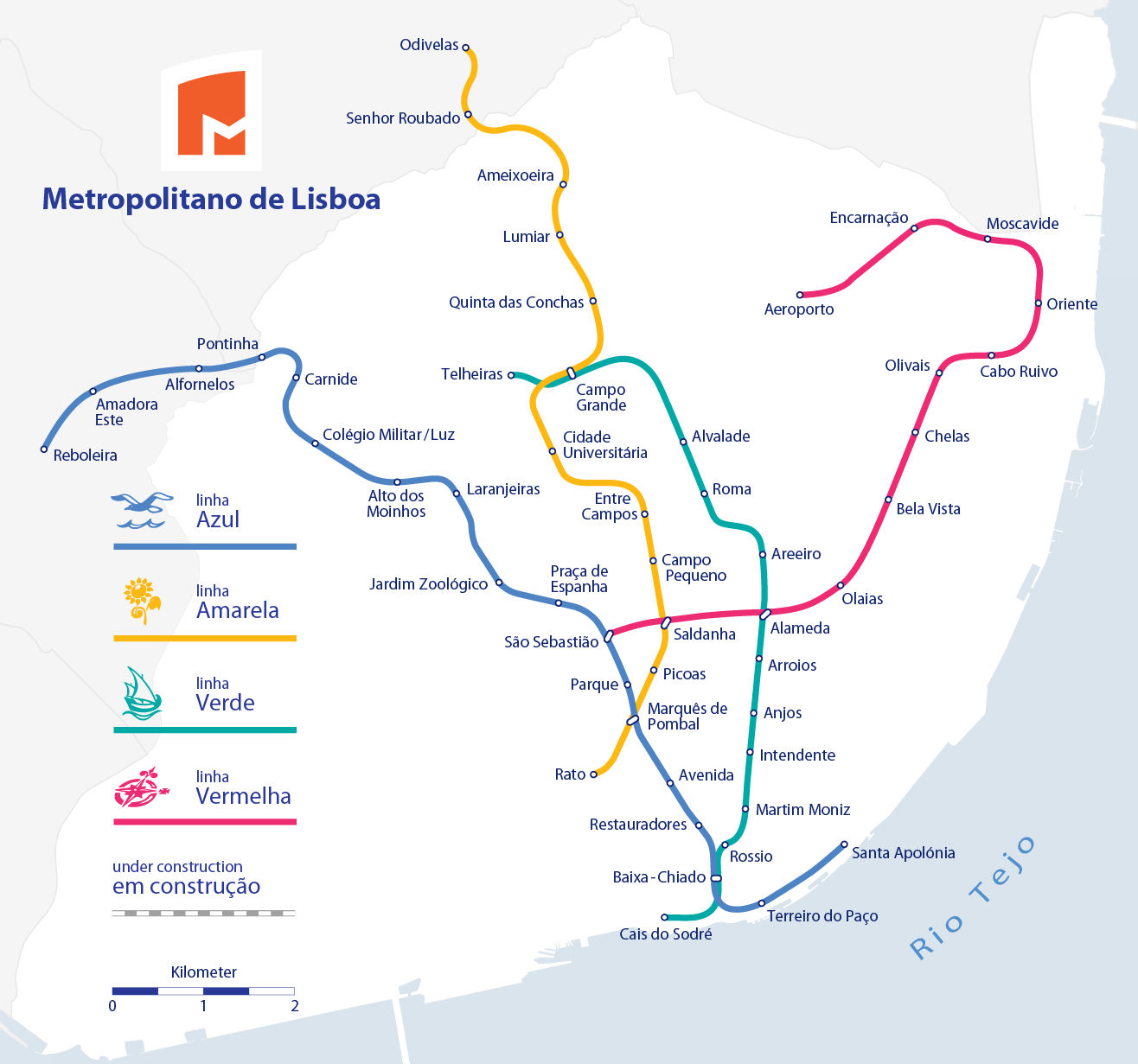
Lisbon metro map 2026: the four lines in operation, with interchange stations at Baixa-Chiado, Marquês de Pombal, Saldanha, Alameda, Campo Grande and São Sebastião.
The Lisbon metro map shows four lines that cross the city like the spokes of a wheel. The Blue Line runs from Santa Apolónia on the river out to Reboleira in the west, the Yellow Line from Rato north to Odivelas, the Green Line from Cais do Sodré to Telheiras, and the Red Line from São Sebastião east to Oriente and the airport. All four meet each other at six interchange stations, which means you can reach almost any point on the network with a single change.
The system opened on 29 December 1959 and has grown to 56 stations across 44.5 km. It carried 176.7 million passengers in 2024, around 484,000 a day, so trains are frequent and stations are busy at rush hour. For visitors the most useful stations sit in a tight cluster in the centre: Baixa-Chiado, Rossio, Restauradores, Terreiro do Paço and Cais do Sodré, all within a short walk of the Old Town and the riverfront.
| Line | Colour and symbol | Route | Stations | Useful for |
|---|---|---|---|---|
| Blue Line (Linha Azul) | Blue, a seagull | Santa Apolónia to Reboleira | 18 | Santa Apolónia station, Baixa-Chiado, Terreiro do Paço, the zoo |
| Yellow Line (Linha Amarela) | Yellow, a sunflower | Rato to Odivelas | 13 | Marquês de Pombal, Saldanha, Campo Pequeno, the university |
| Green Line (Linha Verde) | Green, a caravel | Cais do Sodré to Telheiras | 13 | Cais do Sodré, Rossio, Martim Moniz, Alameda |
| Red Line (Linha Vermelha) | Red, a compass rose | São Sebastião to Aeroporto | 12 | The airport, Oriente, Parque das Nações |
The line symbols are a lovely detail on the Lisbon metro map. Each line has its own emblem, from the seagull of the Blue Line to the caravel of the Green Line, which makes the signs easy to follow even if you cannot read Portuguese. Platforms show the name of the final station on each line, so before you board, find the terminus in the direction you want to travel and follow that sign.
Lisbon Metro Lines Explained: Blue, Yellow, Green and Red Line Stations
Each line on the Lisbon metro map has a different character, and knowing which one serves which part of the city makes planning simple. The lines are short by the standards of larger capitals, so even the longest journey across the network takes well under an hour.
1. Lisbon Metro Blue Line (Linha Azul)
The Blue Line is the longest on the Lisbon metro map, with 18 stations between Santa Apolónia on the river and Reboleira in the western suburbs. For visitors it is the most useful line of all. It stops at Santa Apolónia for long-distance trains, Terreiro do Paço for Praça do Comércio and the ferries, Baixa-Chiado for the shopping streets, and Restauradores and Avenida along the main boulevard. Further out it serves Marquês de Pombal, Parque Eduardo VII and Jardim Zoológico for Lisbon Zoo.
From the Old Town, the Blue Line is usually the first line you use, either from Baixa-Chiado or Terreiro do Paço. It is the easy way to reach Santa Apolónia for trains to Porto and the north, and it connects with the Green Line at Baixa-Chiado, the Yellow Line at Marquês de Pombal and the Red Line at São Sebastião, so it links to every other line on the network.
2. Lisbon Metro Yellow Line (Linha Amarela)
The Yellow Line runs north from Rato, near the Amoreiras district, through Marquês de Pombal, Saldanha, Campo Pequeno and the university area at Cidade Universitária to Odivelas. It has 13 stations and is mainly used by commuters and students, although Campo Pequeno is handy for the bullring concert venue and its shopping centre, and Saldanha is a busy business and hotel district.
Visitors use the Yellow Line less than the others, but it is the quickest link between the Avenida da Liberdade area and the northern neighbourhoods. It meets the Blue Line at Marquês de Pombal, the Red Line at Saldanha and the Green Line at Campo Grande. From early 2027 the Yellow Line will be reorganised when the Circular line opens, so expect new signage and route maps during that change.
3. Lisbon Metro Green Line (Linha Verde)
The Green Line links Cais do Sodré on the river with Telheiras in the north, via Baixa-Chiado, Rossio, Martim Moniz, Intendente, Alameda and Areeiro. Its 13 stations make it the most useful line for the riverfront: Cais do Sodré is the station for the Time Out Market, the Cascais train and the ferry across the Tagus, while Rossio puts you on the city’s grand central square.
Our Cais do Sodré guide covers everything around the Green Line terminus, from the market to the nightlife. The Green Line meets the Blue Line at Baixa-Chiado, the Red Line at Alameda and the Yellow Line at Campo Grande, and it is the line that will form the new Circular route in 2027.
4. Lisbon Metro Red Line (Linha Vermelha)
The Red Line runs from São Sebastião across the east of the city to Oriente and on to Aeroporto. Its 12 stations include Saldanha and Alameda for connections, Olaias with its striking architecture, and Oriente, the transport hub for Parque das Nações, the Oceanário and long-distance trains. Aeroporto station is right inside the arrivals area, which makes the Red Line the cheapest way into the city from a flight.
The Red Line is the newest part of the network and its stations are generally modern, with lifts and wide platforms. It meets the Blue Line at São Sebastião, the Yellow Line at Saldanha and the Green Line at Alameda. An extension west from São Sebastião to Alcântara is planned, which will eventually carry the Red Line towards the river at the western end of the city.
Lisbon Metro Tickets and Prices for 2026: Navegante, Zapping and Contactless
Lisbon metro tickets work on a rechargeable card called the navegante occasional card, which costs €0.50 and can be reused for a year. You load it with either single tickets, a 24-hour ticket or zapping credit, then tap it on the gates as you enter and leave. You can also skip the card entirely and tap a contactless bank card or phone at the gates, which is the simplest option for short stays. The prices in the table are the official 2026 fares that took effect on 1 January.
| Ticket | 2026 price | What it covers |
|---|---|---|
| navegante occasional card | €0.50 | Reusable card to load tickets onto, valid for a year |
| Single Carris/Metro ticket | €1.90 | 60 minutes on metro and Carris buses and trams after first tap |
| Zapping (metro journey) | €1.72 | Pay-as-you-go credit loaded onto the card |
| Contactless bank card or phone | €1.92 | Tap at the gates, no card needed |
| 24-hour Carris/Metro ticket | €7.25 | Unlimited metro, buses, trams and lifts for 24 hours |
| 24-hour Carris/Metro/Transtejo | €10.35 | Adds the ferry to Cacilhas |
| 24-hour Carris/Metro/CP | €11.40 | Adds CP trains to Sintra, Cascais and Azambuja |
| navegante Metropolitano monthly pass | €40 | Unlimited travel across the Lisbon region for a calendar month |
For most visitors, zapping or contactless is the best value. A single metro journey with zapping costs €1.72, so the 24-hour ticket only pays off if you make five or more trips in a day, or if you plan to ride the trams and the Santa Justa lift as well. The 24-hour ticket with CP trains is excellent value for a day trip to Sintra or Cascais. One thing to watch is that one navegante card holds one type of ticket at a time, so each traveller needs their own card.
Buy and top up cards at the ticket machines in every station, which have an English option and accept cards and cash. The official Metropolitano de Lisboa fares page lists the full range of tickets and passes. The monthly navegante passes are aimed at residents, and the free under-23 pass needs Portuguese registration, so visitors are better served by zapping or contactless.
How to Use the Lisbon Metro: Step-by-Step for First-Time Visitors
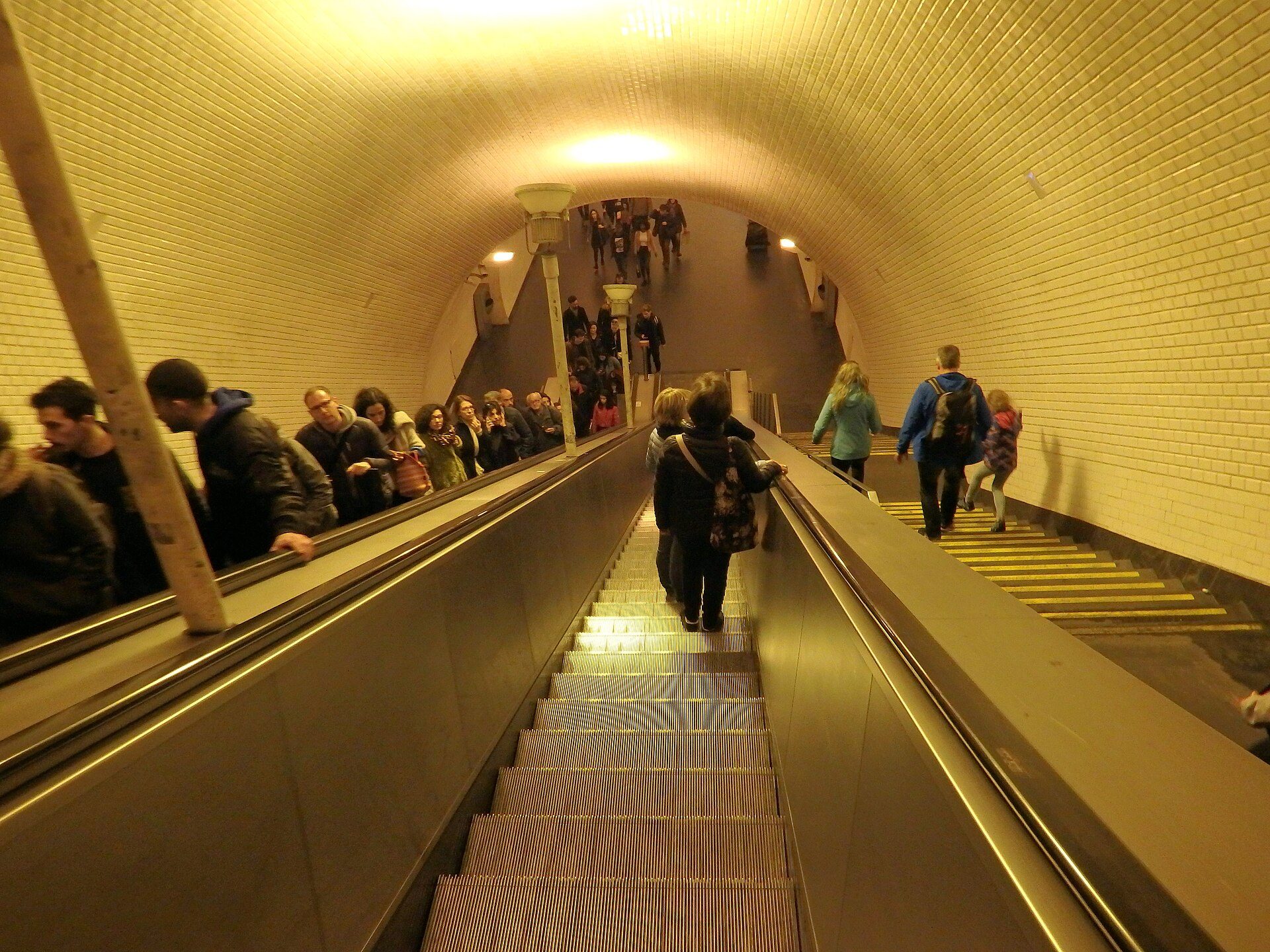
Using the Lisbon metro takes a minute to learn. First decide whether you will pay with a contactless card or a navegante card, then find your line on the Lisbon metro map and note the terminus in your direction of travel. At the gates, tap your card on the reader, walk through and follow the signs with the line colour and the name of the final station. Keep your card or phone handy, because you need to tap again to leave the station.
Lisbon Metro Tips for Visitors
- Tap in and tap out with the same card or phone every time
- Give each traveller their own card, as one navegante card holds only one ticket type
- Load zapping credit for flexibility, or a 24-hour ticket for busy sightseeing days
- Stand on the right on the escalators so others can pass on the left
- Avoid the rush hours of 08:00 to 09:30 and 17:30 to 19:30 when travelling with luggage
- Watch your bags on busy central platforms and in crowded carriages
Changing lines is straightforward. At an interchange station, follow the signs for the colour of your next line, which may involve a walk along tunnels and an escalator or two. Baixa-Chiado is the deepest station in the city centre, with long escalators linking the Blue and Green lines, while Marquês de Pombal and Alameda are simpler changes. Allow five minutes for a change at a busy station, longer with children or suitcases.
Trains run every few minutes for most of the day and a little less often late in the evening and on Sundays. Platform displays show the minutes until the next trains arrive, so you always know how long you have to wait. If you are unsure, metro staff at the ticket offices of the larger stations are helpful and usually speak English.
Lisbon Metro Hours, Frequency and Accessibility in 2026
The Lisbon metro runs from 06:30 until 01:00 every day of the year, with the last trains arriving at the end of each line shortly afterwards. The metro company plans to trial an earlier 05:30 start during 2026, and if the tests go well the earlier opening could become permanent from January 2027, which would be good news for travellers catching early flights. Until then, take a taxi or ride-hailing car for airport departures before 06:30.
Accessibility varies across the Lisbon metro map. Newer stations, especially on the Red Line and the outer sections of the Yellow and Blue lines, have lifts from street to platform. Several older central stations depend on escalators and stairs, and lifts are occasionally out of service. If you are travelling with a wheelchair or a heavy pushchair, check the station facilities on the metro website before you set out, and consider Tram 28 or a taxi for the steepest parts of the Old Town.
Priority seating is set aside in every carriage for older passengers, people with disabilities, pregnant women and those travelling with small children. Lisbon is a friendly city for families, and passengers will often offer a seat to a parent with a baby. Our Lisbon with kids guide has more ideas for getting around the city comfortably with young children.
Lisbon Airport Metro: Getting From the Airport to the City Centre by Metro
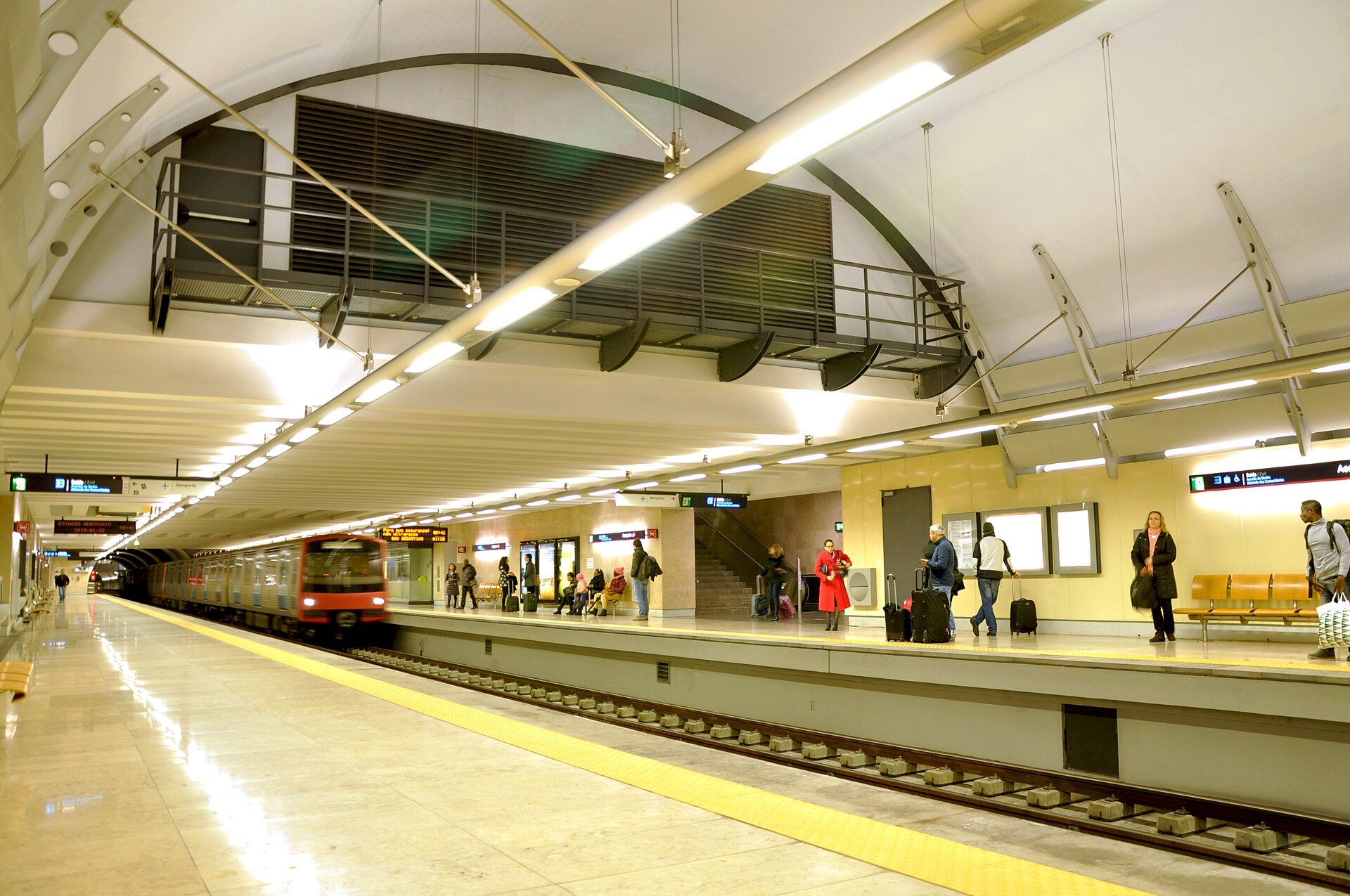
The Lisbon airport metro is the cheapest way into the city. Aeroporto station is the terminus of the Red Line and sits right outside the arrivals hall of Terminal 1, signposted from baggage reclaim. Buy a navegante card from the machines or simply tap a contactless card at the gates, then take any train, since every train from Aeroporto runs towards the city. The ride to Saldanha takes about 16 minutes.
To reach the Old Town and Casa Almada, change at Alameda for the Green Line towards Cais do Sodré and get off at Baixa-Chiado, or change at São Sebastião for the Blue Line towards Santa Apolónia and get off at Terreiro do Paço. Either route takes around 25 to 30 minutes from the airport. From Baixa-Chiado or Terreiro do Paço it is roughly a 10 minute walk to the apartment, slightly uphill.
With several suitcases or tired children, a taxi or ride-hailing car is often the easier choice, taking 20 to 30 minutes to the Old Town depending on traffic. The metro is at its best for light travellers and for the return trip, when you can plan the timing and avoid the morning rush. Allow at least 45 minutes from the Old Town to the airport by metro, plus check-in time.
Lisbon Metro Map 2027: The Circular Line and New Stations Coming Next
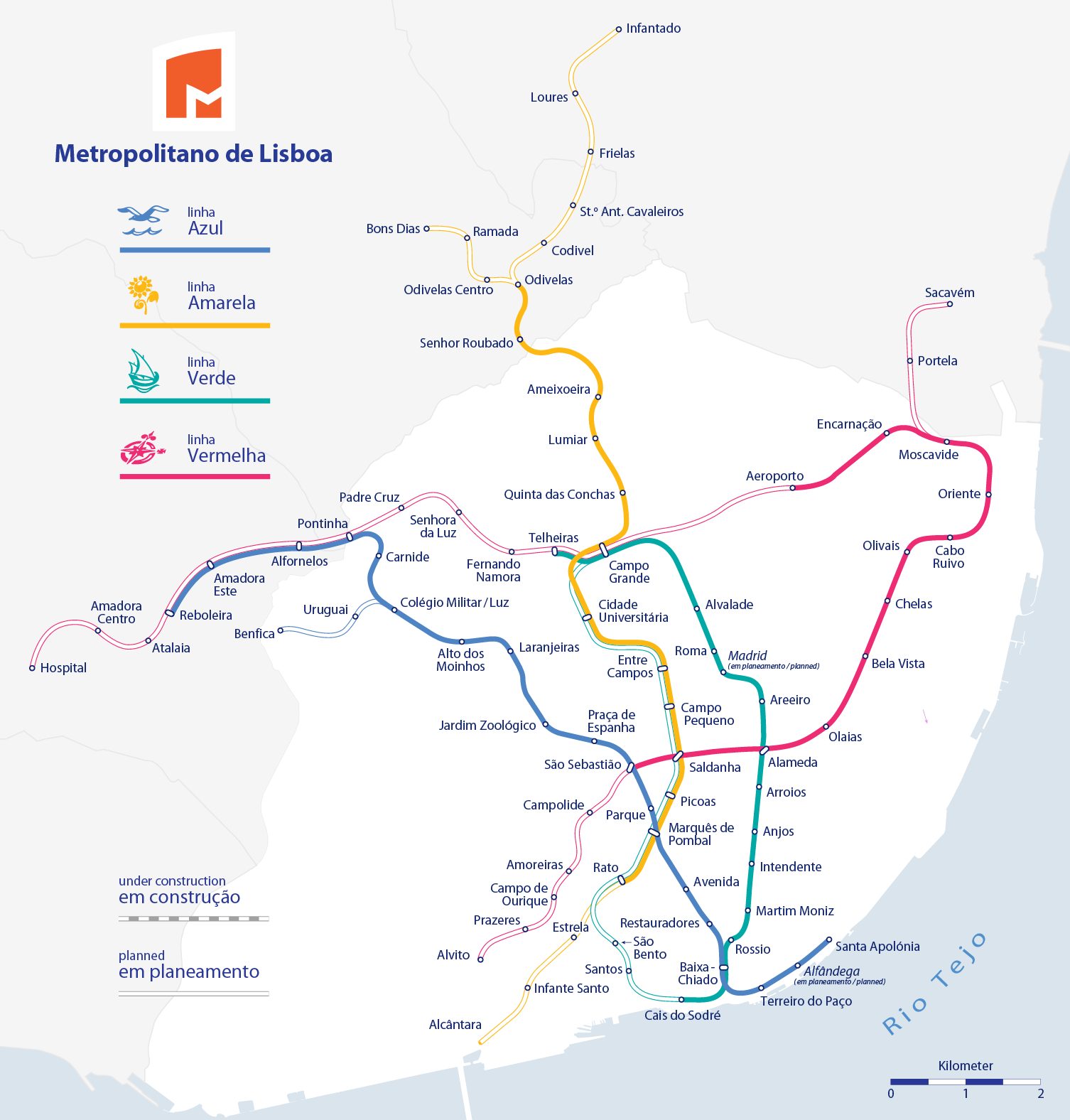
Lisbon metro map with the Circular line under construction through Estrela and Santos, and longer-term planned extensions.
The biggest change to the Lisbon metro map in years is the Circular line, due to open in the first quarter of 2027 with March 2027 as the target date. It joins Rato and Cais do Sodré with about 2 km of new tunnel and two new stations, Estrela and Santos, so that the Green Line becomes a loop through the heart of the city. The Yellow Line will be reorganised at the same time, which means the line colours and routes on the map will change in 2027.
For visitors, the new stations bring the metro to parts of Lisbon that have never had it. Estrela serves the Basílica da Estrela and its gardens, while Santos sits in the design district between Cais do Sodré and Alcântara, close to the river. The loop will also make it easier to travel between the riverfront and Avenida da Liberdade without changing lines. Work began in April 2021, and the project has run more than three years behind its original schedule.
Further ahead, the Red Line is due to be extended 4.1 km west from São Sebastião to Alcântara, with four new stations at Campolide/Amoreiras, Campo de Ourique, Infante Santo and Alcântara. The extension was planned for the end of 2030, but in October 2026 the work was still waiting for approval from the Court of Auditors, so the opening date is likely to slip. A separate light rail Violet Line between Loures and Odivelas is also planned. We will update this Lisbon metro map guide as each opening is confirmed.
Lisbon Metro Stations Worth Seeing for Their Art and Design
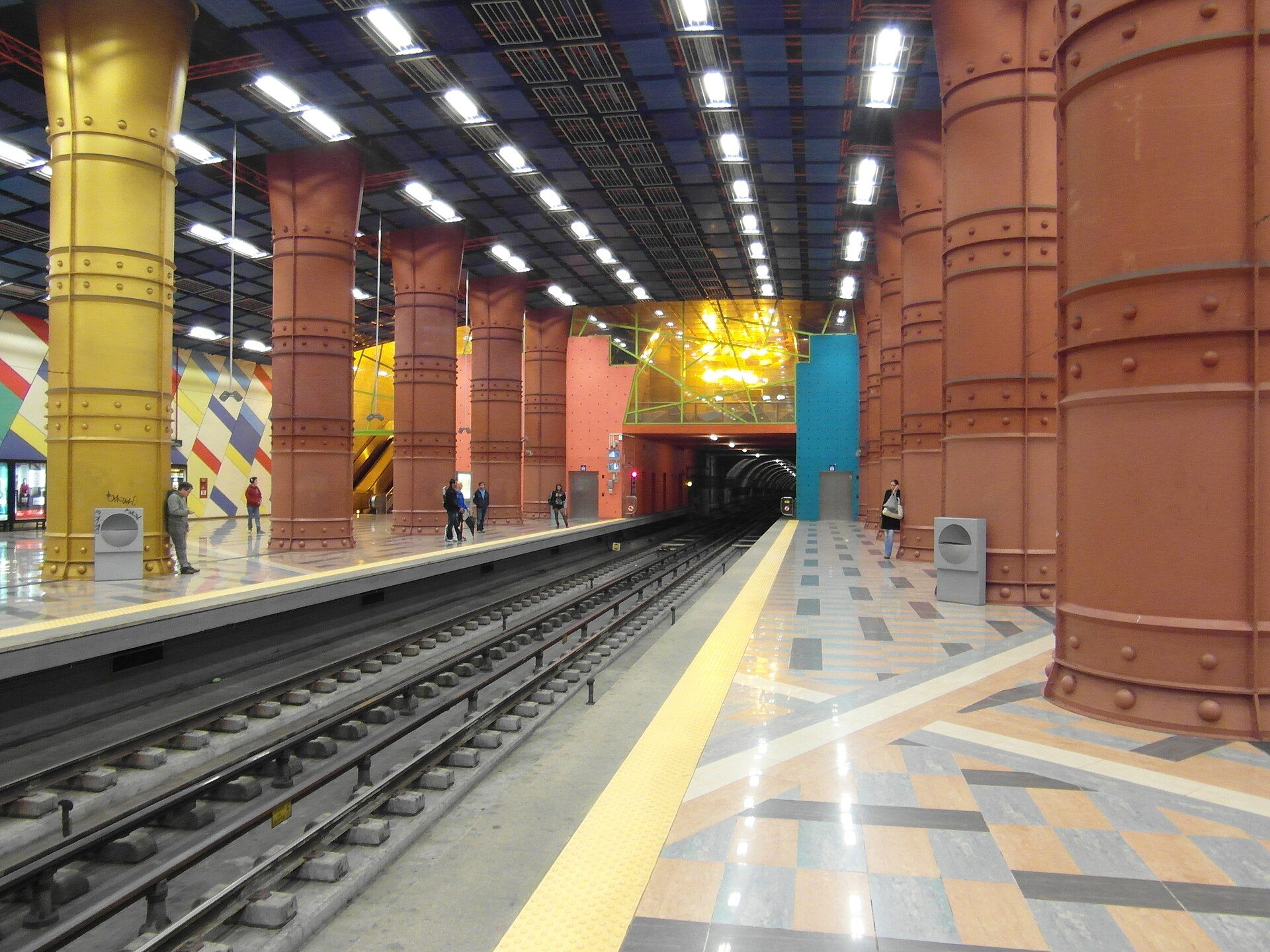
The Lisbon metro is one of the most artistic underground systems in Europe, and several stations are worth a detour in their own right. The early stations were decorated with azulejo tile panels by the artist Maria Keil, whose geometric designs decorated many of the original stations. Later stations commissioned leading Portuguese artists and architects, so a ride across the city is also a tour of modern Portuguese art.
Olaias on the Red Line is the showpiece, with towering painted columns, coloured glass and a vast hall designed by the architect Tomás Taveira for the opening of the Red Line before Expo 98. Parque and Cidade Universitária have striking tile murals too. If you have a 24-hour ticket, hopping off at Olaias and Oriente on the way to Parque das Nações adds very little time and makes the journey memorable.
Art lovers can pair the metro with a visit to the best miradouros in Lisbon, where the city’s tiles and terracotta rooftops are on show above ground. Many of the viewpoints are within a short walk of Baixa-Chiado and Martim Moniz stations.
Lisbon Metro Stations Near Casa Almada in the Old Town
Casa Almada sits in Lisbon’s Old Town, with Tram 28 at the bottom of the street and the Cathedral around the corner. The closest Lisbon metro stations are Baixa-Chiado on the Blue and Green lines and Terreiro do Paço on the Blue Line, each around a 10 minute walk away. From either station you can reach the airport, Santa Apolónia, Cais do Sodré and Oriente with no more than one change, so the whole city is easy to explore from the apartment.
Many guests find they barely need the metro during their stay, because the Baixa, Chiado, Alfama and the riverfront are all within walking distance. The apartment is a 220 m² whole home with three super-king bedrooms that split into singles, two bathrooms, a full kitchen and a private rooftop terrace, and it sleeps up to 9 guests plus 2 infants. Families can see everything we provide for children on our family stays in Lisbon page, and larger families can compare the luxury family apartment.
Casa Almada: Your Old Town Base in Lisbon
A 220 m² whole apartment with three bedrooms, a full kitchen and a private rooftop terrace, about 10 minutes on foot from Baixa-Chiado metro station.


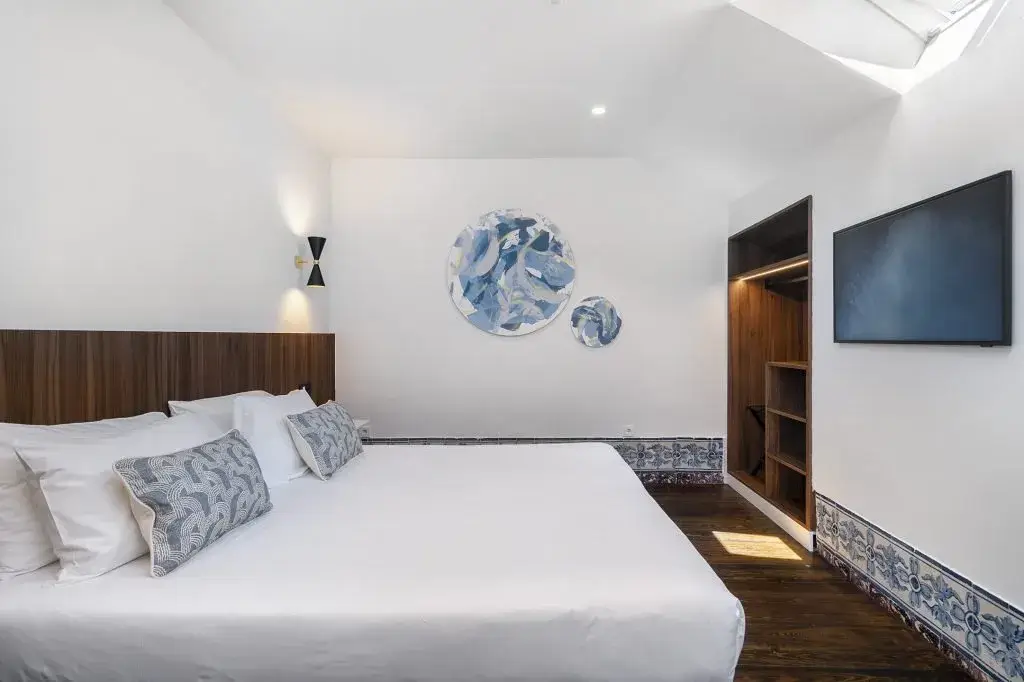
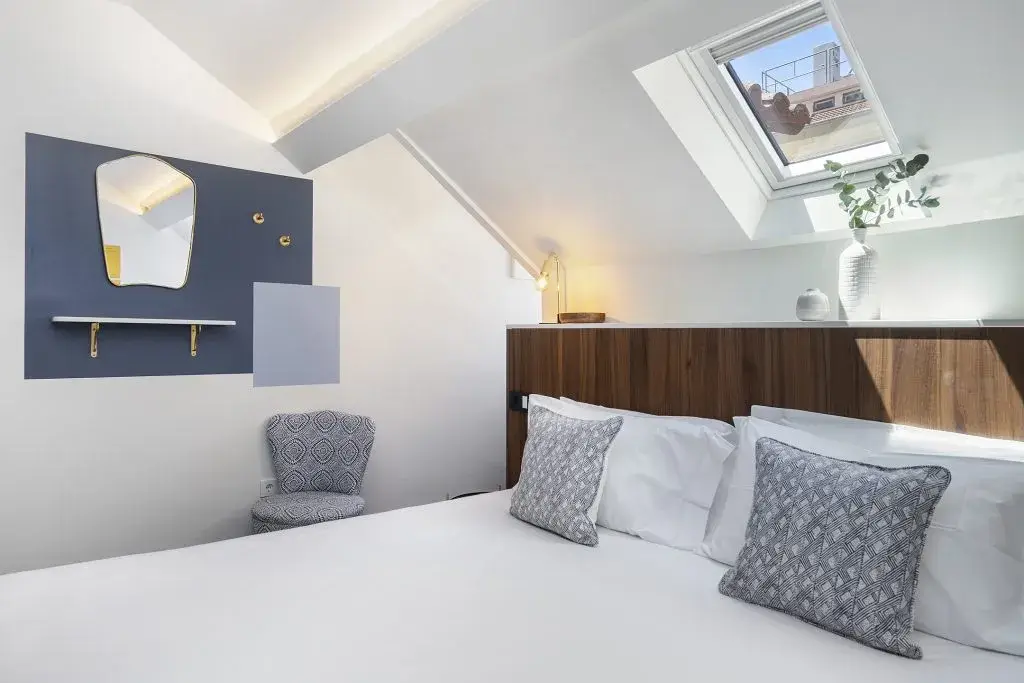
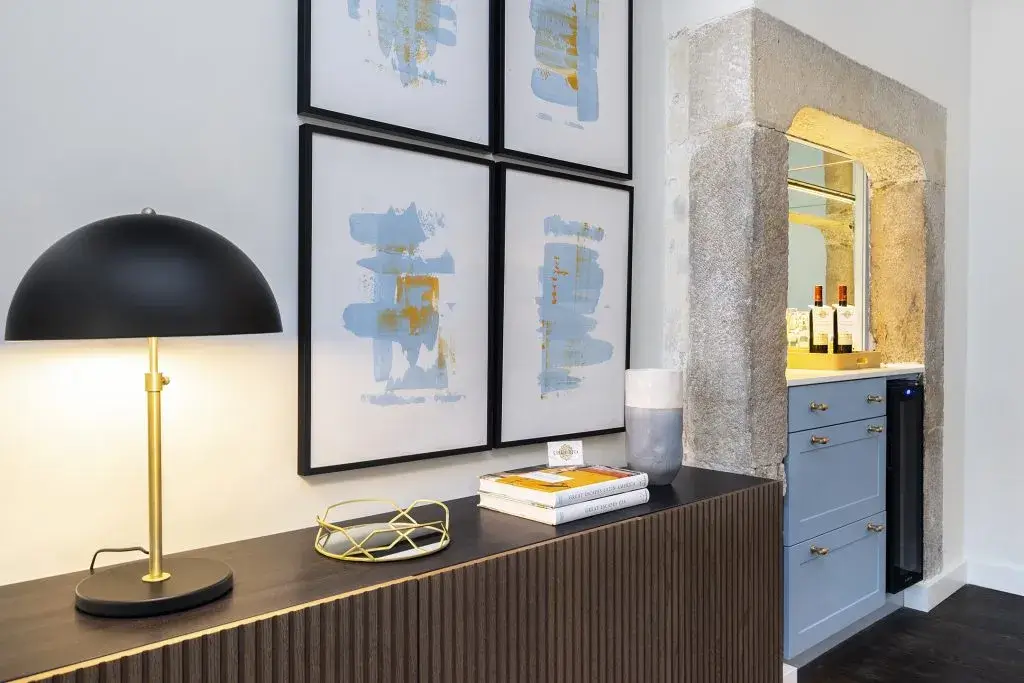
We send every guest directions from the airport and the main stations before they arrive, and we are always happy to suggest the best way across the city for a particular day out. A good plan for the first morning is the walk down to the river at Praça do Comércio, then the Blue Line from Terreiro do Paço out to the sights further afield.

A Note From Susan
“Our guests often tell us how easy the metro makes Lisbon. My tip is to tap a contactless card for short trips and buy the 24-hour ticket with trains on the day you go to Sintra or Cascais. And keep an eye out for the new Circular line in 2027, which will finally bring the metro to Estrela and Santos.”
Susan, founder of Espais Roca
Lisbon Metro Map: Frequently Asked Questions
How Many Lines Does The Lisbon Metro Have?
The Lisbon Metro has four lines in 2026: the Blue Line (Santa Apolónia to Reboleira), the Yellow Line (Rato to Odivelas), the Green Line (Cais do Sodré to Telheiras) and the Red Line (São Sebastião to Aeroporto). Together they cover 44.5 km and 56 stations.
How Much Is A Lisbon Metro Ticket In 2026?
From 1 January 2026 a single Carris/Metro ticket costs €1.90, a metro journey paid with zapping credit costs €1.72, and tapping a contactless bank card costs €1.92. A 24-hour Carris/Metro ticket costs €7.25, and the reusable navegante card costs €0.50.
Can You Pay For The Lisbon Metro With A Contactless Card?
Yes. You can tap a contactless bank card or phone at the metro gates, and each journey costs €1.92 in 2026. Use the same card to tap in and out, and use a separate card for each traveller.
Does The Lisbon Metro Go To The Airport?
Yes. Aeroporto station is the end of the Red Line, inside the airport arrivals area. The ride to Saldanha takes about 16 minutes, and you can reach Baixa-Chiado in the city centre in around 25 to 30 minutes with one change at Alameda or São Sebastião.
What Time Does The Lisbon Metro Open And Close?
The Lisbon Metro runs from 06:30 until 01:00 every day. Trials of an earlier 05:30 start are planned for 2026, with a possible permanent change from January 2027.
When Does The Lisbon Metro Circular Line Open?
The Circular line is due to open in the first quarter of 2027, with March 2027 as the target. It links Rato and Cais do Sodré through two new stations, Estrela and Santos, and creates a loop through the city centre.
Which Lisbon Metro Station Is Closest To The Old Town?
Baixa-Chiado on the Blue and Green lines and Terreiro do Paço on the Blue Line are the closest metro stations to the Old Town and Lisbon Cathedral, each around a 10 minute walk away. Tram 28 is often quicker for the hilltop streets of Alfama and the castle.
Is The Lisbon Metro Accessible With A Pushchair Or Wheelchair?
Many newer Lisbon Metro stations have lifts, but several older central stations rely on escalators and stairs, and lifts are sometimes out of service. Check the Metropolitano de Lisboa website before travelling with a wheelchair or a heavy pushchair, and allow extra time at deep stations such as Baixa-Chiado.
Stay at Casa Almada in Lisbon’s Old Town
A 220 m² whole apartment with three bedrooms, two bathrooms, a full kitchen and a private rooftop terrace, about 10 minutes on foot from Baixa-Chiado and Terreiro do Paço metro stations. Book direct for the best rate.
Check AvailabilityMetro maps by Maximilian Dörrbecker (Chumwa) (CC BY-SA 2.5); photography by Mike Steele (CC BY 2.0), IngolfBLN (CC BY-SA 2.0) and Jaimrsilva (CC BY-SA 4.0), via Wikimedia Commons. Fares and lines last checked 28 October 2026.