
The Short Answer
Planning your stay?
Luxury Apartment Stays at Casa Almada — check availability and book direct.
The Santa Justa Lift is a 45-metre wrought-iron elevator from 1902 that carries you from the flat Baixa streets up to the Carmo and Chiado district, ending at a panoramic viewing platform over the city. A return ride costs around €6 and the queue can run an hour in summer. The smart move is to walk up the hill behind it through Largo do Carmo and reach the same top terrace for free, skipping the line entirely.
Insider Tip
Do not join the line at the bottom. Walk up Rua do Carmo, turn toward Largo do Carmo beside the ruined Carmo Convent, and you arrive at the top of the lift on foot in about five minutes. From there you cross the metal walkway to the viewing terrace, the exact spot the paying riders are queuing an hour to reach. Your transport ticket, or a small €1.50 fee, gets you onto the highest platform.
If there is one structure that stops first-time visitors mid-step in central Lisbon, it is the Santa Justa Lift. Rising straight out of the flat grid of the Baixa like something borrowed from a Jules Verne novel, this neo-Gothic iron tower has been hauling people up the hillside since 1902. Locals call it the Elevador de Santa Justa, and it remains the only one of Lisbon’s old street lifts that runs vertically, like a true elevator, rather than climbing a slope on rails.
It is beautiful, it is genuinely useful, and it is also one of the most over-queued attractions in the whole city. The good news is that almost everything people love about it, the views especially, can be reached without standing in that line at all. This guide explains what the lift is, what tickets and hours to expect, whether it is worth riding, and the free back-door route that gets you to the top terrace while everyone else waits.
Best of all, if you are staying in the heart of Lisbon, it is an easy stroll from the door. We will come back to that at the end.
What is the Santa Justa Lift?
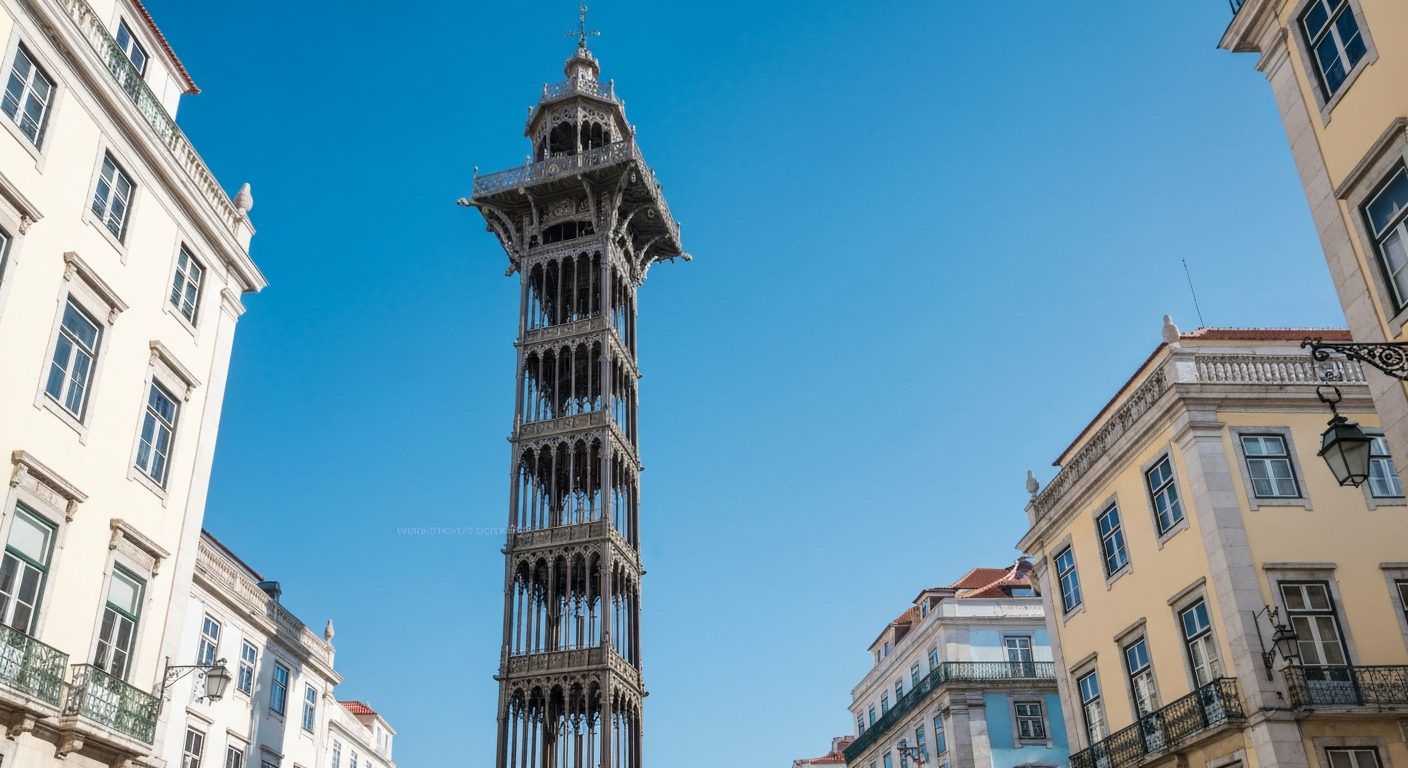
The Santa Justa Lift is a public elevator that connects two parts of central Lisbon sitting at very different heights. At the bottom is the Baixa, the flat, grand, grid-planned neighbourhood rebuilt after the 1755 earthquake. At the top is the Largo do Carmo and the edge of Chiado, perched on the hill above. Between them, until 1902, was a steep, sweaty climb. The lift turned that climb into a 30-second ride inside two polished wooden cabins.
The tower stands 45 metres tall and is built entirely from cast and wrought iron, with delicate filigree arches, two Gothic-revival cabins and a spiral staircase wrapping the top. Its resemblance to the Eiffel Tower is no accident. It was designed by Raoul Mesnier de Ponsard, an engineer who trained in the orbit of Gustave Eiffel, and that French ironwork heritage is written all over it.
Originally it was powered by steam. In 1907 it was converted to an electric motor, which still drives it today. Over a century later it is no longer a serious commuter shortcut so much as a working monument, but it is officially still part of the city transport network, run by Carris, the same company behind the famous yellow trams.
Want to be steps from the Baixa?
Check AvailabilityWhere does the Santa Justa Lift go?
The lift has two stops and one bonus level that catches most people out. Understanding the layout is the key to getting the most out of it, and to deciding whether you even need to ride.
- The bottom entrance: on Rua do Ouro (also signposted as Rua Aurea) in the Baixa, a few steps from Rossio and Praca do Comercio. This is where the cabins start and where the famous queue forms.
- The top exit: the cabins rise to a platform that connects, via an iron footbridge, to the Largo do Carmo up in the Chiado area, right beside the haunting roofless ruins of the Carmo Convent.
- The viewing terrace: above the top exit, a tight spiral staircase climbs to the highest observation deck. This is the panoramic platform everyone photographs, and it is reached separately from the ride itself.
That third level matters. You can arrive at the top entirely on foot from the Carmo side, then climb the spiral stairs to the terrace, without ever queuing for or riding the elevator. The view is identical. We will walk through exactly how to do that further down.
Tickets, hours and the free route

Because the lift is part of the Carris transport system, ticketing is a little quirky. There is a price for the ride, a separate small price for just the top viewpoint, and a way to get the whole thing covered if you already hold a daily transport pass. Here is how it breaks down.
| Detail | What to expect |
|---|---|
| Return ride (single ticket on the spot) | Around €6 |
| Viewing terrace only (separate access) | Around €1.50 |
| With a Carris 24-hour transport ticket | Included, no extra charge to ride |
| Children under 4 | Free |
| Hours (May to October) | Roughly 7:00am to 11:00pm |
| Hours (November to April) | Roughly 7:00am to 10:00pm |
| Viewpoint terrace hours | Generally 9:00am until shortly before lift closing |
| Best free route to the top | Walk up via Rua do Carmo to Largo do Carmo |
The standout detail is that single €6 fare. Buying it just to ride the lift is poor value when a Carris 24-hour ticket (around €6.80, sold at any metro machine and topped onto a reusable Viva Viagem card) covers the lift plus every tram, bus, metro and the other street elevators in the city for a full day. If you are sightseeing across Lisbon anyway, the 24-hour ticket pays for itself within a couple of journeys and the Santa Justa ride is then effectively free.
A few practical notes before you go:
- The single on-the-spot ticket is the most expensive way to do this. Avoid it unless you have no transport pass and simply want the novelty of the ride.
- The viewing terrace is sometimes closed for maintenance even when the lift is running, so the platform access can change. Check the day you visit if the view is your main goal.
- Hours shift with the season and the occasional repair, so treat the times above as a reliable guide rather than a cast-iron promise.
- The lift itself has closed for restoration work at points in recent years. If it is shut, the walk-up route to the Largo do Carmo terrace still gives you the view.
How to skip the Santa Justa Lift queue
This is the part worth memorising. In peak season the line at the bottom entrance regularly stretches to an hour, sometimes more, because the two small cabins carry only a couple of dozen people at a time. The locals’ answer is simple: ignore the queue and walk up the hill instead.
From the bottom of the lift, step past the line and turn up Rua do Carmo, the pedestrian shopping street climbing into Chiado. Take the path toward Largo do Carmo, the square beside the open-roofed Carmo Convent ruins. In around five minutes of gentle uphill walking you reach the top of the lift on its high side, where the iron footbridge meets the street. From here you simply pay the small terrace fee, or use it free with certain passes, and climb the spiral stairs to the same panoramic deck the queue is waiting for.
You see the identical view, you save up to an hour, and you get a short, scenic walk through one of Lisbon’s prettiest corners as a bonus. The only thing you miss is the 30-second ride in the period cabin, which is charming but hardly worth an hour of your day. If you do want that ride for the experience, take it on the way down instead, when queues are usually shorter.
“Excellent location, immaculate and beautifully decorated, with excellent beds and pillows. Lots to do nearby and delicious restaurants close to the apartment, plus great recommendations from the host.”
The view from the top: is it worth it?
The terrace is the real reason to come. From 45 metres up you get an unbroken sweep across the orderly rooftops of the Baixa, out to the Tagus River glinting below, across to Sao Jorge Castle crowning the hill on the far side, and down into the Gothic skeleton of the Carmo Convent right at your feet. On a clear morning it is one of the most complete city panoramas in Lisbon, all the more striking because you are standing inside a piece of 1902 ironwork to see it.
So is it worth it? Honestly, that depends on how you reach it. Paying €6 to ride up, then queuing in the sun for an hour, makes it a frustrating attraction that many visitors leave feeling underwhelmed by. Reaching the same terrace for a euro and a half after a five-minute walk, with no queue, makes it one of the best-value viewpoints in the city. The view does not change. The route to it is what makes or breaks the experience.
If panoramic views are your thing, the Santa Justa terrace pairs well with the free, lift-adjacent miradouros nearby. For a fuller picture of how it fits into a day of sightseeing, our guide to things to do in Lisbon slots it alongside the castle, the trams and the riverside.
How to get to the Santa Justa Lift

The lift sits dead in the centre of Lisbon, where the Baixa meets the rising streets of Chiado, so it is one of the easiest landmarks to reach on foot or by transport.
- Metro: the closest station is Baixa-Chiado on the Blue and Green lines, a two-minute walk from the bottom entrance. Rossio station on the Green Line is also nearby.
- On foot: from Rossio square or Praca do Comercio it is a flat five-minute stroll. The bottom entrance is on Rua do Ouro, also signposted as Rua Aurea, between the two squares.
- Tram and bus: several Carris tram and bus routes pass through the Baixa within a couple of minutes’ walk, and the lift is covered by the same 24-hour transport ticket.
- From the Chiado side: if you are already up in Chiado or Bairro Alto, you can reach the top entrance directly via Largo do Carmo without descending at all.
Because it sits in the most central part of Lisbon, the lift slots neatly into almost any walking day. It is a natural pause between the riverfront, the Rossio cafes and the shops of Chiado, which is one reason it stays so busy. To understand how the Baixa, Chiado and Carmo areas connect to the rest of the city, our breakdown of Lisbon neighbourhoods is a useful companion read.
Staying a short walk from the Santa Justa Lift
One of the quiet luxuries of basing yourself in central Lisbon is that a landmark like the Santa Justa Lift stops being a planned excursion and becomes something you wander past on the way to dinner. Casa Almada sits on Rua do Almada beside Cais do Sodre, a short walk from the river, Time Out Market and the famous Pink Street, with the lift an easy stroll on into the Baixa from there. You can reach it on foot in well under fifteen minutes, no transport needed.
Casa Almada is a 220 m² whole apartment with three bedrooms, original Lisbon art on the walls and its own rooftop terrace with panoramic views across the city skyline, which gives you a private version of the Santa Justa view to come home to at the end of the day. With space for up to nine guests, a fully equipped kitchen, a wine fridge and a genuinely family-friendly setup with baby cot, high chair and toddler beds, it works as well for a multi-generation trip as it does for a couple wanting room to spread out. If you would rather stay in an apartment in Lisbon’s old town than in a standard hotel, this is the kind of central base that puts the whole city within walking distance.
Make Casa Almada your Lisbon home
Casa Almada is a luxury whole apartment in central Lisbon with a rooftop terrace, original local art and room to sleep up to nine. Book direct for the best rate and no booking fees.
Check Dates & Book DirectFrequently Asked Questions
How much is the Santa Justa Lift?
A return ride bought on the spot costs around €6. Access to just the upper viewing terrace is a separate fee of about €1.50. If you hold a Carris 24-hour transport ticket (around €6.80), the ride is included at no extra cost, which is far better value if you are using public transport that day.
Is the Santa Justa Lift worth it?
The view from the top is genuinely excellent, taking in the Baixa rooftops, the river and the castle. Whether the experience is worth it depends entirely on how you reach it. Paying €6 and queuing an hour leaves many people underwhelmed, while walking up via Largo do Carmo and paying the small terrace fee makes it one of the best-value viewpoints in Lisbon.
Is there a free way to the top?
You can walk up to the top of the lift for free by climbing Rua do Carmo to the Largo do Carmo beside the Carmo Convent ruins, which takes about five minutes. From there the footbridge connects to the top of the lift. Reaching the very highest viewing terrace usually still costs a small fee of about €1.50, but you skip the long ride queue entirely.
What are the opening hours?
The lift generally runs from about 7:00am to 11:00pm from May to October, and 7:00am to 10:00pm from November to April. The viewing terrace tends to open around 9:00am and close shortly before the lift. Hours can change for seasons and maintenance, so check on the day if exact timing matters.
How do you skip the Santa Justa Lift queue?
Do not queue at the bottom. Walk up Rua do Carmo to the Largo do Carmo, beside the Carmo Convent, and reach the top of the lift on foot in roughly five minutes. From there you climb the spiral staircase to the viewing terrace, the same platform the queue is waiting for, without joining the line.
Where does the Santa Justa Lift go?
It connects the lower Baixa district, near Rossio and Praca do Comercio, with the higher Largo do Carmo and the edge of Chiado. The bottom entrance is on Rua do Ouro, and the top opens onto a footbridge by the Carmo Convent ruins, with a viewing terrace above.
Who built the Santa Justa Lift?
It was designed by Raoul Mesnier de Ponsard, an engineer who trained in the tradition of Gustave Eiffel, which is why the iron tower so closely resembles the Eiffel Tower. It was inaugurated in 1902, originally steam-powered, and converted to an electric motor in 1907.
Is it included in the Lisboa Card?
The lift is run by Carris and is covered by the Carris 24-hour transport ticket and many transport-based passes. The Lisboa Card includes free public transport, so the lift ride is typically covered by it, though the highest terrace access can be a separate charge. Check the current terms of your specific card before relying on it.